Ways of Siberia
Drum, reindeer and fly agaric
Siberia is vast: endless forests, tundra, frozen rivers and winters that last eight months. Here, between the Urals and the Pacific, hunters, fishers and reindeer herders have lived for thousands of years.
This is also where the word comes from that is known all over the world today: shaman. It comes from the language of the Evenki, šaman, and means roughly «the one who knows» or «the one who is set in motion». Russian travellers brought it to Europe in the 17th century. Since then healers on every continent have been called by this name, although every people has its own words.
The peoples of the north
Siberia is not one people but many. The Evenki move with their reindeer through the taiga, the Nenets through the tundra by the Arctic Ocean. In the far east live the Koryak and the Chukchi, on the Lena the Sakha, once called Yakuts. The Khanty live on the Ob, the Tuvans and Buryats in the south. And in northern Europe, in Lapland, the Sámi are their neighbours, with a related world of drum and song.
Different as their languages are, their picture of the world is similar. Everything is alive: the forest, the fire, the river, the animal that is hunted. Whoever takes must give thanks. And when the balance is lost, someone is needed who can travel between the worlds.
The world tree
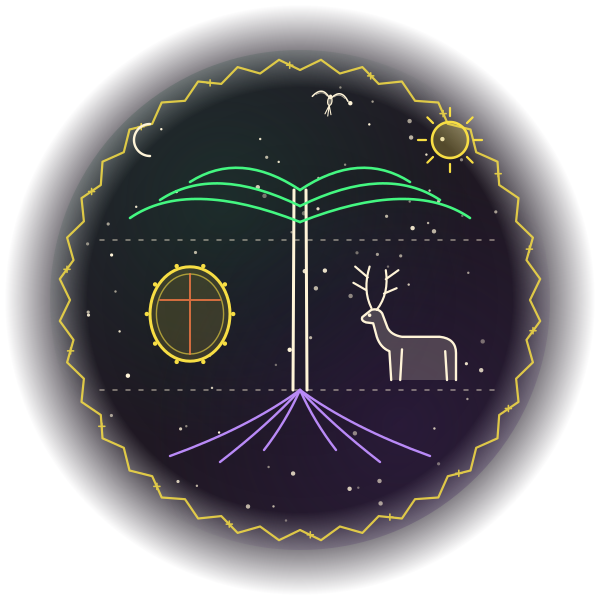
At the centre of the world stands a great tree, often a larch or a birch. Its roots reach into the lower world of the ancestors and the dead, its trunk stands in our middle world, its crown carries the upper world of the sky spirits. Among the Evenki the shaman also follows a great river on his journey that links all three worlds. In the tent the world tree stands as a pole pointing upward through the smoke hole.
The drum – the mount
The drum is the most important tool. Its frame often comes from a tree struck by lightning or shown by the spirits, its skin from a reindeer, elk or horse. Many peoples call it the shaman’s mount or boat: on its steady beat he rides into the other worlds. A new drum is «brought to life» before it is used. When the shaman dies, it is often broken too and left at his grave.
Coat, spirits and song
The shaman’s coat is an image of the world and of the body: pieces of iron as bones, ribbons and fringes as the feathers of a bird, small figures for the helping spirits, often a mirror that wards off evil. The helping spirits appear as animals, as bear, eagle, elk or fish. With song the shaman calls them, with the drum he travels, and the community sits with him in the dark tent and answers.
The calling
No one becomes a shaman because they want to. The spirits choose. It often begins with a serious illness, with dreams and visions known as the shaman’s sickness. In many accounts those called experience being taken apart in a dream and put back together. Whoever accepts the call becomes well and learns for years from an experienced shaman. Whoever refuses it, it is said, stays ill.
Fly agaric and Santa Claus
Every year in December people all over the world tell each other a story: Santa Claus goes back to the shamans of the far north. Many feel there is something true in it – and much speaks for it.
What travellers reported: Among the Koryak, Chukchi, Evenki and other peoples of north-eastern Siberia, the fly agaric (Amanita muscaria) was a sacred being. The Koryak called its spirits wapaq. The mushrooms were dried and eaten in ceremonies. As early as 1730 the Swede Philipp Johann von Strahlenberg wrote that people drank the urine of those who had eaten fly agaric, because the power remains in it. Reindeer love the fly agaric too. Waldemar Jochelson described the life of the Koryak in 1908, and R. Gordon Wasson collected the reports in his book “Soma” in 1968.
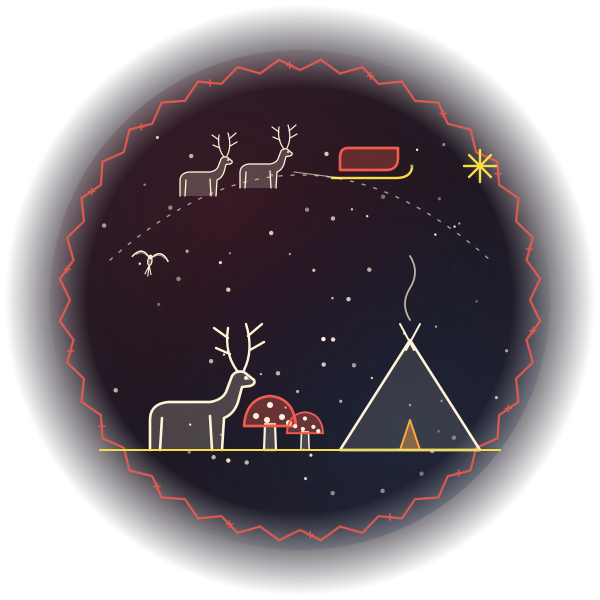
What is told: At the winter solstice the shaman gathered the fly agarics. They grow only beneath conifers and birches, because they are bound to their roots – red-and-white gifts under the tree, just as presents lie under the Christmas tree today. So that the mushrooms could unfold their power, they were hung in the branches to dry, like red baubles on a decorated fir tree. The shaman himself, it is said, wore a red coat trimmed with white fur and tall black boots – dressed like the mushroom he honoured. With a sack full of dried mushrooms he climbed through the smoke hole into the yurt – entrance and “chimney” at once – often along the pole that points up through the roof as the world tree. The reindeer that had eaten the mushroom, and the people who drank their urine, saw themselves flying – across the sky, to the spirits. Red and white are still the colours of the mushroom and of Santa Claus, and in the Alpine countries the fly agaric is still a lucky charm at New Year – the “Glückspilz”, the lucky mushroom.
Other views: Some historians, such as Ronald Hutton, consider this a modern interpretation. They trace Santa Claus back to Saint Nicholas of Myra, to the 1823 poem “A Visit from St. Nicholas”, in which the eight reindeer first appear, and to twentieth-century advertising. But their view, too, rests on what happened to be written down. Much of the life of the Siberian peoples was never recorded or was lost in times of persecution, and history was often written by those with their own intentions. The old knowledge of these peoples did not live in books; it was passed on from person to person, from experience to experience. That something was not written down does not mean it was not so. What is handed on in this way carries the truth at its core, if it is true – and what is not true comes to light in time, on both sides.
What exactly is true, nobody today can say with certainty – neither one side nor the other. I like the old trail from the north. Feel for yourself which story speaks to you.
Important
The fly agaric is poisonous. Ibotenic acid and muscimol can cause vomiting, confusion, seizures and severe poisoning, and it is easily mistaken for the deadly panther cap. What is written here is cultural history, not a guide. Please do not imitate it. In case of poisoning in Switzerland: Tox Info Suisse, phone 145.
Persecuted and found again
Under the tsars many peoples of Siberia were baptised; under the Soviet Union the shamans were persecuted. They were called frauds and enemies of progress, their drums were taken away and some were sent to camps. Many stopped or carried on in secret.
Since the 1990s the old ways have been returning. In Tuva, Buryatia and among the Sakha there are again shamans, their own associations and festivals. Often they have to piece together what was lost: from the memory of the elders, from songs and from the notes of researchers.
With respect
Much of what is sold in the West as «Siberian shamanism» has little to do with the peoples of Siberia. Those who wish to be close to them first listen: to the people themselves, to their songs, to their history of persecution and new beginnings. Drums, coats and rituals belong to the communities they come from.
Sources
Mircea Eliade: Schamanismus und archaische Ekstasetechnik, 1951 · Waldemar Jochelson: The Koryak, 1908 · Philipp Johann von Strahlenberg: Das Nord- und Ostliche Theil von Europa und Asia, 1730 · R. Gordon Wasson: Soma – Divine Mushroom of Immortality, 1968 · Anna-Leena Siikala: The Rite Technique of the Siberian Shaman, 1978 · Piers Vitebsky: The Shaman, 1995 · Ronald Hutton: Shamans – Siberian Spirituality and the Western Imagination, 2001 · James Arthur: Mushrooms and Mankind, 2003 · Carl A. P. Ruck et al.: The Hidden World – Survival of Pagan Shamanic Themes in European Fairytales, 2007 · Wikipedia: Shamanism
The content was created with AI.