Shipibo Traditions
Where songs become patterns
On the Ucayali, one of the great headwaters of the Amazon in eastern Peru, live the Shipibo-Conibo. They call themselves Jonikon, true people, and their language Non Joi, our language.
Their world is woven through with patterns. The women embroider and paint them on fabrics, vessels and faces; the healers sing them in the night. For the Shipibo these patterns are not decoration: they are songs you can see, and songs that heal.
The dieta my Schools of Life tell of comes from their tradition. The plant beings tell of the plants they live with.
Kené – songs you can see
The patterns
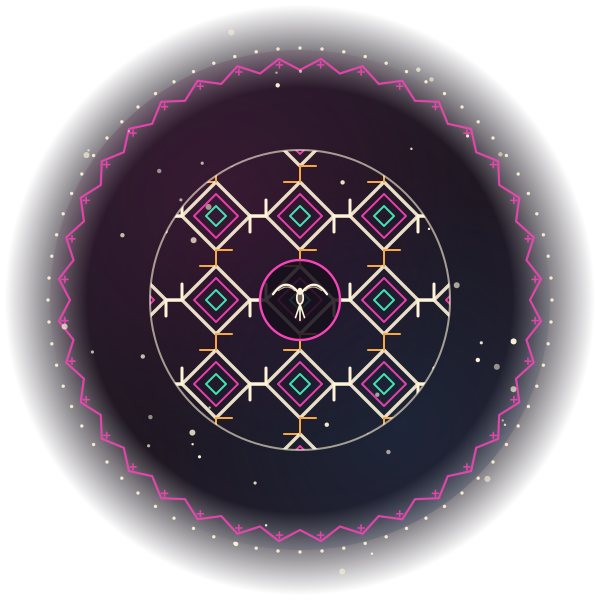
Kené are the geometric patterns of the Shipibo: crosses, diamonds, hooks and paths of bold and fine lines that branch out without ever ending. There are many kinds – maya kené with curves, koros kené with crosses, embroidered kewé. Since 2008 they have been protected in Peru as national cultural heritage.
Ronin, mother of the patterns
All patterns, the Shipibo tell, bear the skin of Ronin, the cosmic anaconda. She lives in the water, she shaped the world, and on her body all the kené of the world are united. Whoever paints kené draws from this source.
The knowledge of the women
Kené is above all the art of the women. They embroider it on the chitonti, the skirt, paint it on kempo, the clay vessels, and on face and body. Girls learn it from mothers and grandmothers – and from the plants: traditionally a drop of juice from kené waste, a kind of piri-piri, is put into their eyes so that they may see and dream the patterns. Often a pattern arises freely from the mind, and two women can paint together on one cloth without agreeing beforehand.
Ikaros, dieta and healing
Onanya – those who know
Onanya is the name for the healer – literally: the one who knows. Whoever has gone very far and meets the spirits is called meraya. Their knowledge does not come from books but from the plants themselves, learned over long years of dieta. Many onanya are women.
Sama – the dieta
In sama, the dieta, one withdraws, eats simply, without salt, sugar or spices, gives up closeness and distraction – and takes in a plant: the bark of a tree, a root, a flower. For weeks or months it teaches in dreams, feelings and images. What one receives in the dieta is often songs.
Ikaros – the healing songs
Bewa means song, rao bewa healing song, in Spanish ikaro. In the ceremony the onanya sings, often softly, often for hours, accompanied only by the rustling of the leaf rattle. It is said that she sees the kené that have fallen into disorder in the body of a sick person and sings the patterns whole again. With koxonti, singing over something, a medicine, a water or a scent is also charged with the power of the song. Above all stands protection, panati, laid around the person like an invisible pattern.
Oni and the plant teachers
Oni is the name of the brew made from ayahuasca, the vine nishi, and the leaves of chacruna, kawa. It opens sight into the other worlds. Rome, mapacho tobacco, protects and cleanses. And great trees such as lupuna, renaco or ayahuma are teachers with a spirit of their own.
The worlds and their beings
Sky, earth and water
The world, nete, has several layers. Above us lies nai, the sky, with bari, the sun, oxe, the moon, and the stars in which the dead live on. In the middle is mai, the earth on which we walk. And beneath the water lies jene nete, the world of water, a world full of cities, beings and light. At the very top waits jakon nete, the good world, the land without evil.
Ibo – the masters of things
Every plant, every animal, every lake has its ibo, its master or owner spirit. The onanya speaks with it and asks it for help. There are luminous beings, chaikoni, and difficult ones, yoshin. Whoever lives in the forest or by the river never lives alone.
Beings of water and forest
In the river live the yakumama, the mother of the water, and the yakuruna, the people of the water world. The pink river dolphin can, it is said, take human form and lure people to the underwater cities. In the forest you meet the chullachaki, the guardian of the forest with the uneven foot. And the jaguar, ino, is the mightiest among the animals.
Life on the river
Villages on the Ucayali
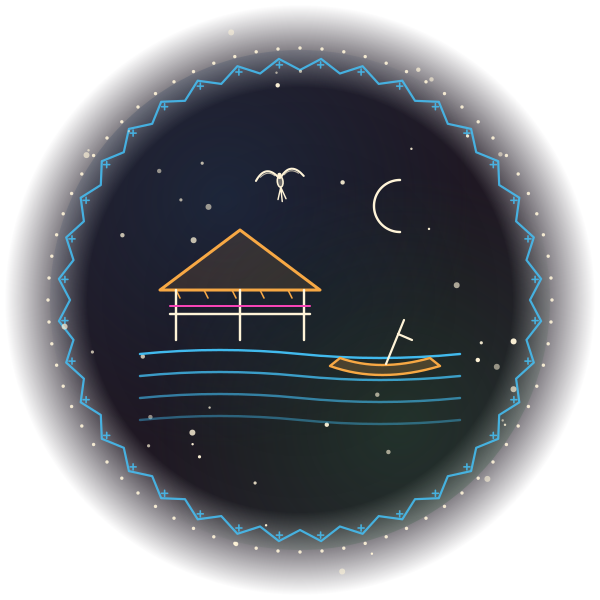
Most Shipibo live in villages along the Ucayali and its side channels, many also in the city of Pucallpa. The houses stand on stilts, the roofs are thatched with palm leaves. The river gives fish and a way to travel, the gardens give cassava, plantains and maize. Masato, the drink of festivals, is brewed from cassava and ferments in large painted clay vessels.
Festivals
Ani xeati, the great festival, used to last several days and celebrated, among other things, the coming of age of girls – with songs, masato and dances. Today it is hardly celebrated any more. What lives on are the masha, the dance and festival songs, and the joy of dressing in kené.
Between forest and city
Deforestation, oil extraction and drug trafficking press on the land along the river. Many young Shipibo move to the cities. In Cantagallo, in the middle of Lima, lives a whole Shipibo community that lost almost everything in a fire in 2016 and kept on painting. When in 2020 the pandemic cost many elders and onanya their lives, young Shipibo went from house to house with healing plants as the «Comando Matico». The knowledge lives – because it is passed on.
With respect
The knowledge of the Shipibo is in demand worldwide today – and not always to their benefit. Kené patterns are copied and sold without the women who created them gaining anything, and around ayahuasca a business has grown up in which not everyone who calls themselves a healer is one. Whoever buys kené does best to buy directly from the artists or their associations. And whoever seeks a ceremony or a dieta takes their time, asks questions and trusts their feeling.
Sources
Angelika Gebhart-Sayer: Die Spitze des Bewusstseins – Untersuchungen zu Weltbild und Kunst der Shipibo-Conibo, 1987 · Luisa Elvira Belaunde: Kené – Arte, ciencia y tradición en diseño, Lima 2009 · Wikipedia: Shipibo-Conibo people
The images were created with AI.