Lakota Traditions
Mitákuye Oyás’iŋ – all my relatives
On the prairies of South and North Dakota, around Ȟe Sápa, the Black Hills, live the Lakota. Together with the Dakota and Nakota they form the Očhéthi Šakówiŋ, the Seven Council Fires.
Their life revolves around one simple, great word: Mitákuye Oyás’iŋ – all my relatives. The bison, the eagle, the stone, the wind, the person beside you: everything is related, and you are in relationship with everything.
Much was taken from them – the land, the bison, for a long time even the right to hold their ceremonies. And yet they sing, pray and dance – to this day.
The sacred and kinship
Wakȟáŋ Tȟáŋka – the Great Mystery
Wakȟáŋ means holy, mysterious, full of power. Wakȟáŋ Tȟáŋka is the Great Mystery, often translated as «Great Spirit» – not a figure in the sky, but the sacred that works in everything. In prayer it is addressed as Tȟuŋkášila, Grandfather, and the earth as Uŋčí Makȟá, Grandmother Earth. Íŋyaŋ, the stone, Tȟaté, the wind, and Wakíŋyaŋ, the Thunder Beings, also belong to this sacred whole.
Mitákuye Oyás’iŋ – all my relatives
A prayer ends with these words, and with them one enters the sweat lodge. They exclude no one: the two-legged, the four-legged, the winged ones, the plants, the stones. Life itself is a web of relationships – and each of them wants to be cared for.
Thiyóšpaye – the extended family
Life is carried by the thiyóšpaye, the kin group of many related families. Children have many mothers and fathers, grandparents are teachers. Among the values that are passed on are wówačhaŋtognake, generosity, wóohitika, courage, wówaȟwala, humility, and wóksape, wisdom. Whoever has much gives much – respect comes from sharing, not from owning.
The sacred hoop and the four directions
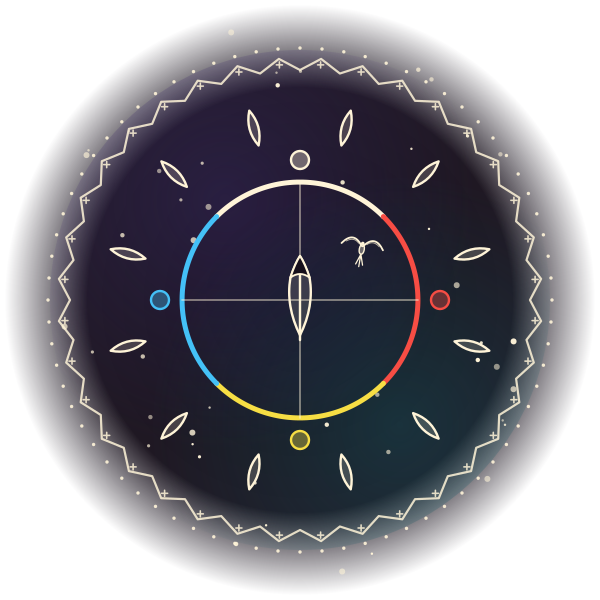
Everything the power of the world does is done in a circle – so the Oglala Black Elk told it. The sky is round, the sun and moon move in a circle, the seasons return, the tipi and the camp circle are round. In the sacred hoop the four directions cross, each with its colour and its powers. With Black Elk they are black in the west, white in the north, red in the east and yellow in the south – other families and communities arrange the colours differently. Then there are the sky above, the earth below and the centre, where you yourself stand.
White Buffalo Calf Woman and the pipe
Ptesáŋwiŋ
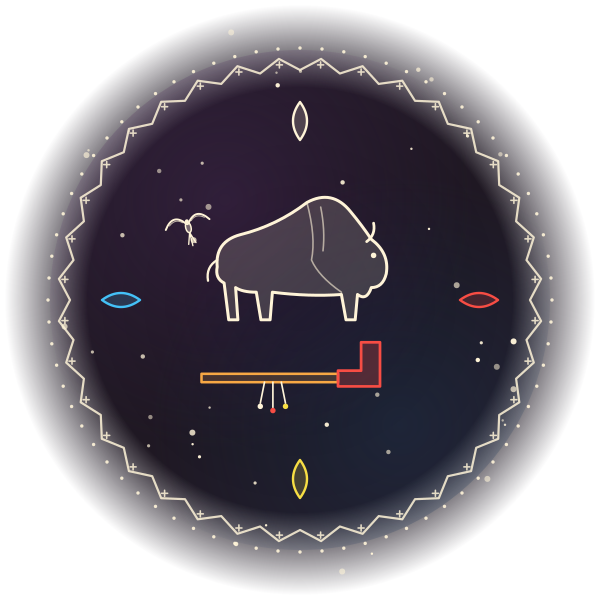
In a time of hunger, the Lakota tell, a beautiful woman in white appeared to two young hunters. One desired her and perished in a cloud. The other went back to the camp and prepared for her coming. Ptesáŋwiŋ brought the people the sacred pipe and taught them to pray with it. As she left, she turned into a bison and finally into a white buffalo calf. Since then the birth of a white bison has been seen as a sacred sign – as in 1994, when the white calf «Miracle» was born in Wisconsin.
Čhaŋnúŋpa – the sacred pipe
The bowl of red pipestone stands for the earth and its people, the wooden stem for everything that grows. Whoever fills the pipe calls the directions and all beings into it with every pinch of čhaŋšáša, red willow bark, or čhaŋlí, tobacco. The rising smoke carries the prayer. To hold a pipe means to speak the truth. The original pipe of Ptesáŋwiŋ is still kept today at Green Grass on the Cheyenne River Reservation – its keeper in the nineteenth generation is Arvol Looking Horse.
Sacred plants
Pȟežíhota, prairie sage – a close relative of our mugwort –, purifies and is burned and laid out in ceremonies. Wačháŋǧa, sweetgrass, is braided and with its scent calls in the good powers. And wasé, the red earth paint, marks sacred things and people.
The seven sacred rites
Gifts of Ptesáŋwiŋ
With the pipe, tradition says, seven rites came to the people. Black Elk told them to the ethnologist Joseph Epes Brown in the 1940s; the book «The Sacred Pipe» made them known worldwide. The pipe is present in every one of them.
The seven rites
- Wanáǧi Yuhápi – keeping of the soul: The soul of someone who has died is lovingly kept, often for a year, and then released.
- Inípi – the sweat lodge: In the dark womb of the earth, over glowing stones, body, mind and heart are purified.
- Haŋbléčheya – the vision quest: Alone on a hill, without food or water, for up to four days and nights – one «cries for a vision».
- Wiwáŋyaŋg Wačhípi – the Sun Dance: In summer people dance for four days around the sacred tree and give their sacrifice for the life of the people.
- Huŋkápi – making relatives: People become relatives in a ceremony and take responsibility for one another.
- Išnáthi Awíčhalowaŋpi – the ceremony for girls: At her first menstruation a girl is honoured as a woman and prepared for her power.
- Tȟápa Waŋkáyeyapi – throwing the ball: A girl throws a ball towards the directions; whoever catches it receives a blessing – an image of the knowledge that comes to all.
Songs, drum and dance
Čhaŋčhéǧa, the drum, is seen as the heartbeat of the earth; waǧmúha, the gourd rattle, calls the spirits. Without olówaŋ, the songs, there is no ceremony. At the wačhípi, the powwow, families come together from far away, dance, honour their veterans and their dead, eat and laugh together. And heyókȟa, the sacred clown who does everything backwards, reminds us that laughter, too, is sacred.
Sacred places and history
Ȟe Sápa – the Black Hills
For the Lakota the Black Hills are the heart of everything that is. The Treaty of Fort Laramie granted them to the Lakota «forever» in 1868. Six years later an expedition under Custer found gold; in 1877 the USA took the land. In 1980 the US Supreme Court ruled that this had been unlawful and awarded the Lakota compensation. They have never accepted the money – with interest it has since grown to well over a billion dollars. «The Black Hills are not for sale.»
Matȟó Pahá and Matȟó Thípila
Matȟó Pahá, Bear Mountain (Bear Butte), rises alone from the prairie at the edge of the Black Hills. For generations people have gone up it for the vision quest, and to this day prayer cloths and tobacco ties hang in its trees. Matȟó Thípila, the Bear Lodge, is the rock tower the maps call Devils Tower. The bear here is guardian and healer.
Waníyetu Wówapi – the winter counts
The Lakota counted years in winters. For each year the community chose an event, and a keeper painted a picture of it on a bison hide – the winter of the many falling stars, the winter the horses came. Thus a painted history arose over many generations. The names of the moons can be found in the Lakota dictionary.
Mní Wičhóni – water is life
In 2016 and 2017 thousands of people from many nations gathered at Standing Rock to pray and protest against an oil pipeline beneath the Missouri. Their call «Mní wičhóni» went around the world. It tells what the Lakota have always been about: protecting life for those who come after us – seven generations ahead.

With respect
The ceremonies of the Lakota are living religion, not cultural goods to take away. In 1993 the Lakota, Dakota and Nakota spoke out in a joint declaration against the exploitation of their spirituality, and in 2003 Arvol Looking Horse asked that people who do not belong to these nations not take part in the vision quest and the Sun Dance. I share here what I have learned – as knowledge and as a bow, not as instructions. Whoever wants to go deeper will find the way through the people themselves and their own voices.
Sources
Joseph Epes Brown (ed.): The Sacred Pipe – Black Elk’s Account of the Seven Rites of the Oglala Sioux, 1953 · John G. Neihardt: Black Elk Speaks, 1932 · Lakota Language Consortium: New Lakota Dictionary · Wikipedia: Lakota people, Black Hills, White Buffalo Calf Woman, Sun Dance
The images were created with AI.