Celtic Traditions
In the circle of the year
Long before there was a Switzerland, Celts lived here. They gave the rivers names that have remained to this day. They celebrated the light when it returned and honoured the dark when it came. In trees, springs and stones they saw beings with a soul – and in time not a line, but a circle.
Much of this is lost. They did not write their knowledge down, they passed it on: from mouth to ear, from heart to heart. What remains are finds in the ground, accounts by their enemies, later legends from Ireland and Wales, names on the map.
And a feeling that sometimes rises when you walk through the fog in November.
The wheel of the year
The wheel of the year
The Celts did not count from morning to morning but from evening to evening: first comes the night, then the day. And so the year, too, began with its dark half.
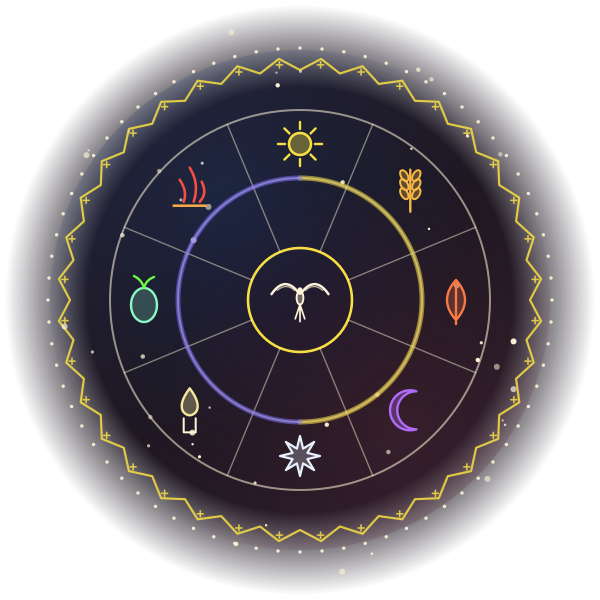
Today the cycle of the year is usually told as a wheel with eight festivals – four fire festivals that open the seasons and four sun festivals at the solstices and equinoxes. A festival roughly every six weeks, one breath of the year.
Samhain · around 1 November
The threshold to the dark time and, for many, the beginning of the new year. The herds came down from the pastures, the harvest was gathered in. On this night, it was believed, the veil to the Otherworld is especially thin – the ancestors are near. By many detours it became Halloween, and it is no coincidence that All Saints’ and All Souls’ Day fall on the same days.
Winter solstice · around 21 December
The longest night. From here on the light grows again. Even the builders of Newgrange in Ireland, long before the Celts, aligned their passage tomb so that on these mornings the rising sun shines into the innermost chamber. The name often used today, Yule, comes from the Germanic north.
Imbolc · around 1 February
The first stirring of spring beneath the snow. The ewes lamb and give milk again. The festival belongs to Brigid, goddess of fire, poetry, healing and the forge – later venerated as Saint Brigid. Candlemas on 2 February carries this light on.
Spring equinox · around 20 March
Day and night are of equal length; now the scales tip towards the light. The seed goes into the earth. The name Ostara goes back to an Anglo-Saxon goddess Eostre mentioned by the monk Bede – it is Germanic, not Celtic.
Beltane · around 1 May
The festival of fire and of blossoming abundance. In Ireland cattle were driven between two fires to bless them before they went up to the summer pastures. The maypole, May fires and Walpurgis Night tell of the same joy of life.
Summer solstice · around 21 June
The longest day; the sun stands at the height of its power. Fires burn on the hills, herbs such as St John’s wort are gathered. The name Litha is an old Anglo-Saxon month name.
Lughnasadh · around 1 August
The festival of the god Lugh, master of all arts: the beginning of the harvest, the first bread from new grain. In England it lives on as Lammas, the «loaf mass». And in Switzerland bonfires burn on the heights on 1 August – a custom of more recent times, but a beautiful coincidence.
Autumn equinox · around 22 September
Balance once more; now it tips towards the dark. A time of thanks for the abundance: fruit, nuts, grapes. The festival only received the name Mabon, after a figure of Welsh legend, in the 1970s.
Good to know
What is attested above all are the four fire festivals Samhain, Imbolc, Beltane and Lughnasadh – from old Irish texts. That people observed the solstices is shown by stone settings that are often much older than the Celts. The wheel of eight festivals and the names Yule, Ostara, Litha and Mabon were put together in the 20th century, mainly in the English Druid and Wicca movements. It is not a handed-down Celtic calendar – but a beautiful way to walk through the year mindfully.
Tree script and tree calendar
Ogham – the tree script
Ogham is the oldest script of the Irish language. Around 400 inscriptions from the 4th to 6th centuries survive, most of them in Ireland, some in Wales, Scotland and on the Isle of Man. The signs are notches and strokes along an edge, usually the edge of a stone, and are read from bottom to top. Almost always they name people – on grave and boundary stones.
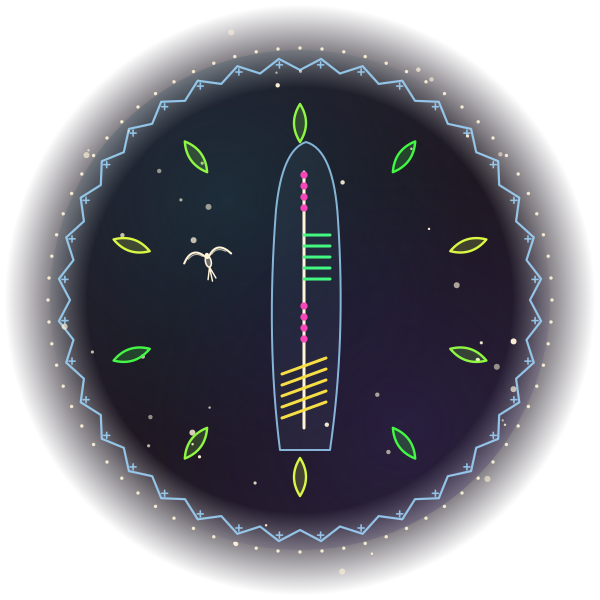
The alphabet has twenty signs in four groups of five. By the way, the picture beside this shows a name in ogham: R – E – N – E.
The letters and their trees
- B · Beith · birch
- L · Luis · rowan
- F · Fearn · alder
- S · Sail · willow
- N · Nion · ash
- H · hÚath · hawthorn
- D · Dair · oak
- T · Tinne · holly
- C · Coll · hazel
- Q · Ceirt · apple tree
- M · Muin · vine or bramble
- G · Gort · ivy
- NG · nGéadal · reed or broom
- Z · Straif · blackthorn
- R · Ruis · elder
- A · Ailm · pine or fir
- O · Onn · gorse
- U · Úr · heather
- E · Edad · aspen
- I · Idad · yew
The assignment to trees and plants comes from medieval Irish teaching texts such as the «Auraicept na nÉces». Not every letter name originally meant a tree – the tree script is also a piece of later, loving interpretation.
The Celtic tree horoscope
Anyone who looks up their «Celtic tree of life» meets the tree horoscope: 22 trees spread over the year, a tree for every birthday. Poetic as it is, it has nothing to do with the ancient Celts. It goes back to the French journalist Paule Delsol, who designed it in 1971 for the magazine Marie Claire, inspired by Robert Graves’ book «The White Goddess». A game of our time with old images – and yet an invitation to see the trees as kin.
Celts in Switzerland
The Helvetii
In Caesar’s time the Helvetii lived on the Swiss plateau between the Jura, the Alps, Lake Geneva and the Rhine – a federation of four sub-tribes, among them the Tigurini and the Verbigeni. In 58 BC they set out south-west with their families, were defeated by Caesar at Bibracte and had to return. Caesar’s account is the first written record of them – told by the victor. Their name lives on: Helvetia, and in the CH for Confoederatio Helvetica.
La Tène – a place on Lake Neuchâtel
A whole era bears a Swiss name. At La Tène, at the north-eastern end of Lake Neuchâtel, hundreds of swords, spears, shields and brooches came to light from 1857 onwards – probably offerings placed in the water. Since then the later Iron Age, roughly 450 BC to the turn of the era, has been called the La Tène period. Much of it can be seen at the Laténium in Hauterive.
Traces in the landscape
- Mont Vully – a Celtic hillfort (oppidum) high above the lakes of Murten and Neuchâtel
- Bern, Enge peninsula – a Celtic town in the loop of the Aare; a small zinc tablet bears the name Brenodor
- Basel – the Basel-Gasfabrik settlement and later the oppidum on the cathedral hill
- Uetliberg near Zurich – a princely grave from around 500 BC
Names that have remained
Many places and rivers still bear Celtic names today. Thun comes from «dunum», fortified place. Yverdon was Eburodunum, the yew fort. Solothurn was called Salodurum, Winterthur Vitudurum, Geneva Genava. And the Rhine, «Renos», is simply: the flowing one.
Customs with old roots?
Fires on the heights at the solstice, bonfires on the Sunday after carnival, the noisy driving-out of winter, turnip lanterns in November: much of it recalls the Celtic wheel of the year. Whether it really goes back to the Celts can usually not be proven – Romans, Alemanni and Christianity have reshaped everything several times over. Perhaps that does not matter so much. The people in these valleys have always celebrated the light when it came, and lit its way when it left.
Druids and world view
The druids
They were priests, judges, teachers, healers and keepers of knowledge. Caesar reports that their training took up to twenty years. Learning was done in verse, by heart – the teaching was not to be written down. Their name is often interpreted as «those who know the oak» or «the very knowing ones».
Mistletoe and oak
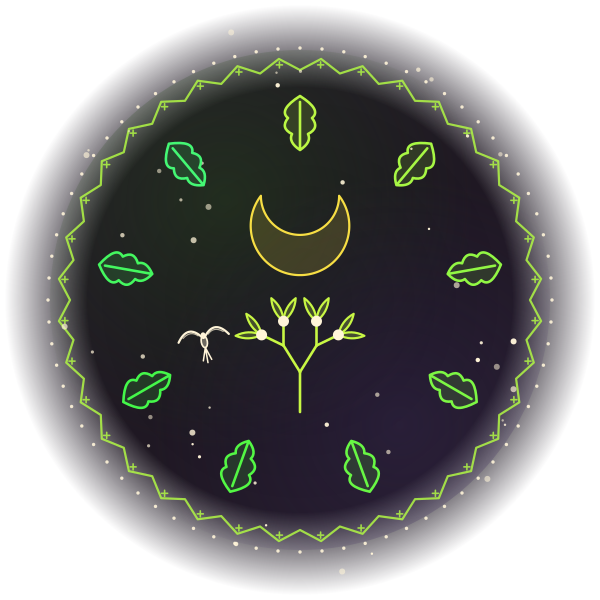
According to Pliny the Elder, the druids held nothing more sacred than the mistletoe and the tree on which it grows – if it is an oak. On the sixth day of the moon a druid in a white robe cut it with a golden sickle, and it was caught in a white cloth before it could touch the ground.
The Otherworld
For the Celts the world of the gods, the fairies and the ancestors did not lie far away in the sky, but very close: beneath the hills – the Irish síd –, beyond the sea, behind the mist. It opened at the thresholds: between day and night, between land and water, between the old year and the new.
Sacred places
For a long time they needed no temples of stone. Groves – «nemeton» –, springs, lakes, bogs and hilltops were sacred. They placed their offerings in springs and lakes, as at La Tène. Many a sacred spring later became a chapel or a place of pilgrimage.
Soul and return
Caesar writes that the druids taught that the soul does not perish but passes into another after death – which is why the warriors did not fear death. The triskele, the triple spiral, is often read today as an image of becoming, being and passing away. How the Celts themselves understood it, they did not leave us.
Sources
Gaius Julius Caesar, De bello Gallico, books I and VI · Pliny the Elder, Naturalis historia XVI, 249–251 · Laténium, archaeology park and museum, Neuchâtel · Historical Dictionary of Switzerland · Wikipedia: Celts, Helvetii, La Tène culture, Ogham, Druid
The images were created with AI.