The Wheel of the Year and the Moon
In the rhythm of sun and moon
Before there were clocks, there was the sky.
The moon waxed and waned, and whoever watched it knew when to sow, when to harvest, when to celebrate. The sun rose and sank on the horizon, and at its turning points fires were burning.
Here the wheel of the year turns – for your place and for today. See where you are standing right now.
Samhain
The threshold to the dark time and, for many, the beginning of the new year. The herds came down from the pastures, the harvest was gathered in. On this night, it was believed, the veil to the Otherworld is especially thin – the ancestors are near. By many detours it became Halloween, and it is no coincidence that All Saints’ and All Souls’ Day fall on the same days.
Winter solstice
The longest night. From here on the light grows again. Even the builders of Newgrange in Ireland, long before the Celts, aligned their passage tomb so that on these mornings the rising sun shines into the innermost chamber. The name often used today, Yule, comes from the Germanic north.
Imbolc
The first stirring of spring beneath the snow. The ewes lamb and give milk again. The festival belongs to Brigid, goddess of fire, poetry, healing and the forge – later venerated as Saint Brigid. Candlemas on 2 February carries this light on.
Spring equinox
Day and night are of equal length; now the scales tip towards the light. The seed goes into the earth. The name Ostara goes back to an Anglo-Saxon goddess Eostre mentioned by the monk Bede – it is Germanic, not Celtic.
Beltane
The festival of fire and of blossoming abundance. In Ireland cattle were driven between two fires to bless them before they went up to the summer pastures. The maypole, May fires and Walpurgis Night tell of the same joy of life.
Summer solstice
The longest day; the sun stands at the height of its power. Fires burn on the hills, herbs such as St John’s wort are gathered. The name Litha is an old Anglo-Saxon month name.
Lughnasadh
The festival of the god Lugh, master of all arts: the beginning of the harvest, the first bread from new grain. In England it lives on as Lammas, the «loaf mass». And in Switzerland bonfires burn on the heights on 1 August – a custom of more recent times, but a beautiful coincidence.
Autumn equinox
Balance once more; now it tips towards the dark. A time of thanks for the abundance: fruit, nuts, grapes. The festival only received the name Mabon, after a figure of Welsh legend, in the 1970s.
Sun, moon and people
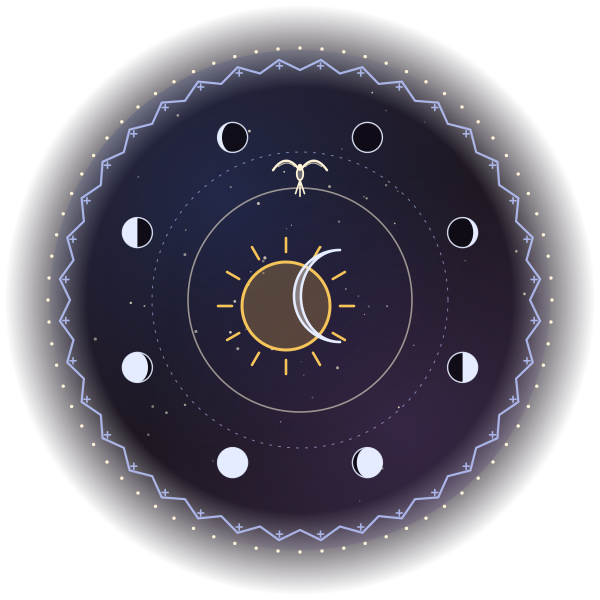
A lunar month – from new moon to new moon – lasts a little over 29 ½ days. Twelve of them are eleven days shorter than a solar year. That is why full and new moons travel through the calendar every year, and sometimes two full moons fall in the same month. Today the second one is called a “blue moon”.
The solstices and equinoxes, on the other hand, are fixed by the earth’s path around the sun. They always fall around the 20th to 22nd of a month – calculated exactly here in the wheel, to roughly the minute. The four fire festivals Samhain, Imbolc, Beltane and Lughnasadh lie in between, on their traditional days. They were celebrated from the evening before: for the Celts, the day began with the night.
The old month names in the calendar go back to Charlemagne, who had German names established for the months around the year 800 – so his biographer Einhard reports. They tell of the farmers’ year: pasture, hay, harvest, wood and wine.
Good to know
Everything on this page is calculated in your browser – using the astronomers’ formulas, simplified, but accurate to about an hour. The times apply to your time zone. Nothing is sent or stored.
The day sign of the Cholq’ij, the sacred calendar of the Maya, follows the usual count, in which 21 December 2012 was the day 4 Ajpu. This is also how the ajq’ij in the highlands of Guatemala count.
To the Celtic traditions To the Maya traditions To the Warriors of the Rainbow