Andean Traditions
Where the mountains speak
The Andes are the longest mountain range on earth. They stretch for more than seven thousand kilometres from Venezuela to Tierra del Fuego. In their high valleys and on the wide Altiplano millions of people who speak Quechua or Aymara still live today, above all in Peru, Bolivia and Ecuador, but also in northern Chile and Argentina and in southern Colombia.
Long before the Inca, cultures such as Chavín, Paracas, Nazca, Moche, Wari and Tiwanaku arose here. The Inca brought much of this together into an empire larger than any other in the Americas of their time. It fell after 1532. What remained lives on in the villages: in the offerings to Pachamama and the mountains, in the festivals, in weaving, in music and in a language spoken by some eight to ten million people.
This page follows above all the Quechua and Aymara of southern Peru and Bolivia.
The world of the Inca
The Inca did not call themselves by that name. Inca was the title of the ruler. Their empire was called Tawantinsuyu, and in only about a hundred years it grew from the valley of Cusco to Ecuador, Chile and Argentina.
Tawantinsuyu – the land of the four parts
Tawantinsuyu means “the four parts that belong together”. From Cusco, the navel of the world, four quarters went out: Chinchaysuyu in the north-west, Antisuyu in the east towards the rainforest, Kuntisuyu in the west towards the sea and Qullasuyu in the south around Lake Titicaca. A network of sacred lines, the ceques, linked Cusco with more than three hundred holy places, the huacas. The world was ordered, and the centre held it together.
Qhapaq Ñan – the Inca road
More than thirty thousand kilometres of roads linked the empire, over passes at almost five thousand metres, through deserts and across suspension bridges of woven grass. Along them ran the chaskis, relay runners who carried messages from station to station and announced themselves with a conch horn. In this way a message travelled more than two hundred kilometres in a day. Since 2014 the Qhapaq Ñan has been a UNESCO World Heritage Site, and the bridge of Q’eswachaka is still rewoven together every year.
Khipu – knowledge in knots
The Inca had no writing like ours, but they had the khipu: a main cord with many coloured cords hanging from it, knotted in different forms and at different distances. The knots show numbers in the decimal system. With them the khipukamayuq, the keepers of the knots, recorded harvests, tributes and the number of people. Some researchers believe that khipus also preserved stories and names. More than a thousand survive, and only part of them is understood.
Wiraqucha, Inti and Lake Titicaca
In the beginning, the myths tell, Wiraqucha, the creator, rose from Lake Titicaca. He made the sun, moon and stars rise from the Isla del Sol and shaped the peoples. Inti, the sun, was regarded by the Inca as their father, Mama Killa, the moon, as their mother. From the lake also came Manco Cápac and Mama Ocllo, the first Inca couple, with a golden staff. Where it sank effortlessly into the earth, they founded Cusco.
Chakana – the Andean cross
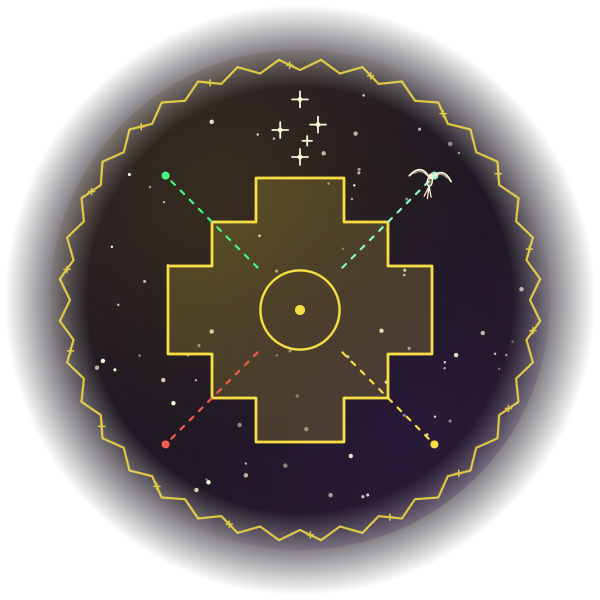
The chakana is a stepped cross with a circle at its centre. Chakay means to bridge, and chakana is the bridge or ladder. It connects the three worlds and the four directions, and its centre is Cusco or one’s own place. Many also see the Southern Cross in the night sky in it. Whether the Inca interpreted it exactly this way is not certain, but today it is the best-known sign of the Andean peoples, on textiles, jewellery and flags.
Festivals and ceremonies
Whoever lives in the Andes lives in conversation with Pachamama and the mountains. The ceremonies range from a small greeting before a meal to pilgrimages with tens of thousands of people. What the word Pachamama means is explained on a page of its own: Pachamama.
Despacho – a letter to the earth
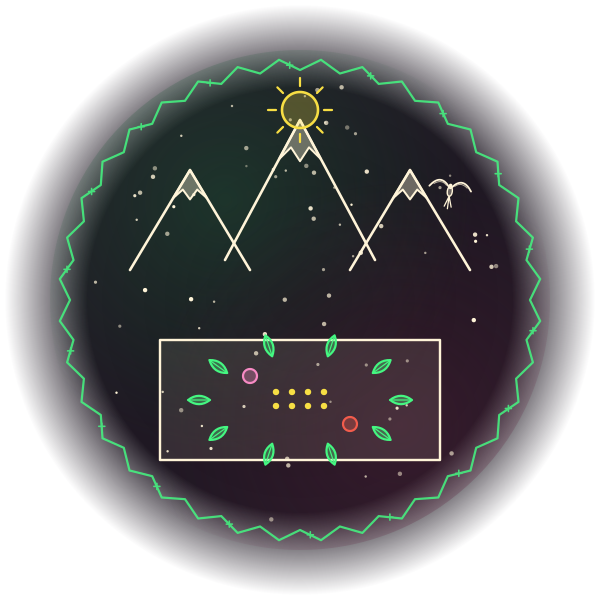
The despacho, in Spanish also called “Pago a la Tierra”, a payment to the earth, is a bundle of offerings. On a sheet of white paper the paqo lays layer upon layer: coca leaves, seeds, maize, beans, flowers, sugar and sweets, llama fat, coloured threads, sometimes shells and gold paper. Each gift carries a prayer. Then the paper is folded, tied and burned or buried. In this way the letter goes to Pachamama and the apus. A despacho is given in thanks, when building a house, for health or for a good journey.
K’intu – three leaves for the mountains
A k’intu is three fine, whole coca leaves laid out as a small fan. You hold it in front of your mouth, breathe your breath over it, the samay, and say the names of the apus and of Pachamama. Then you pass the k’intu on, place it in a despacho or chew it. When people meet, too, they exchange coca leaves. This is how almost every conversation, every task and every prayer begins in the Andes.
Inti Raymi – the festival of the sun
At the winter solstice in June the sun stands at its lowest in the Andes. The Inca then celebrated the great festival of the sun in Cusco, so that it would return and the year would begin anew. The Spanish rulers banned it in 1572. Since 1944 Inti Raymi has been celebrated again every year on 24 June, with music and dance on the Plaza de Armas and a great re-enactment before the zigzag walls of Saqsaywaman. Many villages celebrate their own festivals at the same time.
Qoyllur Rit’i – the star in the snow
Qoyllur Rit’i means something like “brilliant white snow” or “star of the snow”. Every year, a week before Corpus Christi, tens of thousands of people climb into the Sinakara valley near Ausangate, to more than four thousand six hundred metres. Groups of dancers from many villages go along. The ukukus, half human, half bear, climb onto the glacier at night. They used to bring ice down to the valley as holy water; today they leave it up there, because the glacier is shrinking. Since 2011 the pilgrimage has been part of UNESCO’s intangible cultural heritage.
Willkakuti – the return of the sun
On 21 June, at the winter solstice, the Aymara celebrate their new year: Willkakuti, the return of the sun. During the night thousands gather in Tiwanaku, the ancient city near Lake Titicaca. When the first rays come over the mountains, everyone raises their hands to receive the sun’s new strength. Since 2009 the day has been a public holiday in Bolivia. The Aymara count their own year, reaching back more than five thousand five hundred years.
Healing and knowledge
In the Andes healing is not only about the body. Illness is often seen as a sign that the balance with the community, the ancestors or Pachamama has been disturbed.
Paqo, yatiri and Kallawaya
Those who speak with Pachamama and the apus are called paqo in southern Peru and yatiri, “the one who knows”, among the Aymara. Many are called, for instance by a lightning strike or through dreams, and then learn for a long time from elders. Their most important tool is the mesa, a cloth holding sacred stones, the khuyas. In Bolivia the Kallawaya have travelled through the Andes for centuries as wandering healers, with knowledge of almost a thousand plants. Their knowledge is part of UNESCO’s cultural heritage.
Mama Kuka – the sacred leaf
The coca plant has been sacred in the Andes for thousands of years. Chewing the leaves, akulliku or chakchay, helps against hunger, cold and altitude and is part of every gathering. Those who know read the leaves: they throw a handful onto a cloth and interpret how they fall. The leaf is not the same as the cocaine extracted from it in laboratories. Bolivia and Peru still defend its traditional use before the United Nations today.
Life today
The villages of the Andes have changed, and many young people move to the cities. And yet much that was true even before the Inca lives on in everyday life.
Ayllu and minka – strong together
The ayllu is the community of families who belong together, with their land, their ancestors and their mountains. Work is often done together: in the minka the whole village builds a bridge, cleans an irrigation channel or thatches a roof, and afterwards everyone eats and drinks together. Then there is ayni, the help that people give back to one another. Many communities still choose their own office holders today, in rotation.
Weaving – patterns that speak
In the Andes weaving is one of the oldest arts, older than pottery. Women weave cloths, ponchos and belts from alpaca and sheep’s wool on the backstrap loom. Every village has its patterns, telling of lakes, mountains, rivers, animals and the seasons of the year. On the island of Taquile in Lake Titicaca the men knit too, and their caps show whether they are married. This textile art has been part of UNESCO’s cultural heritage since 2008.
Potato, maize and llama
The potato comes from the Andes. Farmers there know thousands of varieties, in every colour and shape, and plant them at different altitudes so that something always thrives. In the frosty nights of winter potatoes are left to freeze and then dried in the sun. This makes chuño, which keeps for years. Then there are maize, quinoa and beans on the old terraces, and llamas and alpacas, which give wool and dung and carry loads.
Siku, quena and charango
The music of the Andes lives on the wind. The quena is a notched flute of cane, the siku a panpipe of two rows. A siku is often played by two people: one row is called ira, the other arka, and only by alternating does the melody arise. This is how ayni sounds as music. The charango, a small lute, came with the stringed instruments of the Spaniards and was reinvented in the Andes. With it beats the big drum, the bombo.
Wounds and resistance
In 1532 the Spaniards under Francisco Pizarro captured the Inca Atawallpa at Cajamarca, and soon afterwards the empire fell. Forced labour in the silver mines of Potosí followed, along with epidemics and the ban on the old ceremonies. Again and again the people rose up, most powerfully around 1780 with Túpac Amaru II in Peru and Túpac Katari in Bolivia. It is said that before his death Túpac Katari declared: “I will return, and I will be millions.” In the war in Peru from 1980 to 2000, too, it was above all Quechua speakers who suffered. Yet the language, the festivals and the offerings to Pachamama live on.
With respect
Many Andean ceremonies are sold to travellers today, and much of what is offered as “Inca wisdom” has little to do with the people in the villages. The Quechua and Aymara are living peoples with their own communities, languages and rights. Those who meet them do best to buy textiles directly from the weavers and their cooperatives, respect the sacred places, bring a gift when invited, coca leaves for example, and ask before taking photos.
Sources
Catherine J. Allen: The Hold Life Has – Coca and Cultural Identity in an Andean Community, 1988/2002 · Brian S. Bauer: The Sacred Landscape of the Inca – The Cusco Ceque System, 1998 · Terence N. D’Altroy: The Incas, 2002/2014 · Gary Urton: Signs of the Inka Khipu, 2003 · Josef Estermann: Andine Philosophie (Andean Philosophy), 1999 · Comisión de la Verdad y Reconciliación (Peru): Final Report, 2003 · UNESCO: Qhapaq Ñan (2014), Qoyllur Rit’i (2011), Taquile textile art (2008), Andean cosmovision of the Kallawaya (2008) · Wikipedia: Inca Empire
The content and images were created with AI.